
Combining machine learning algorithms for bridging gaps in GRACE and GRACE Follow-On missions using ERA5-Land reanalysis
Published in Science of Remote Sensing, 2025
Abstract
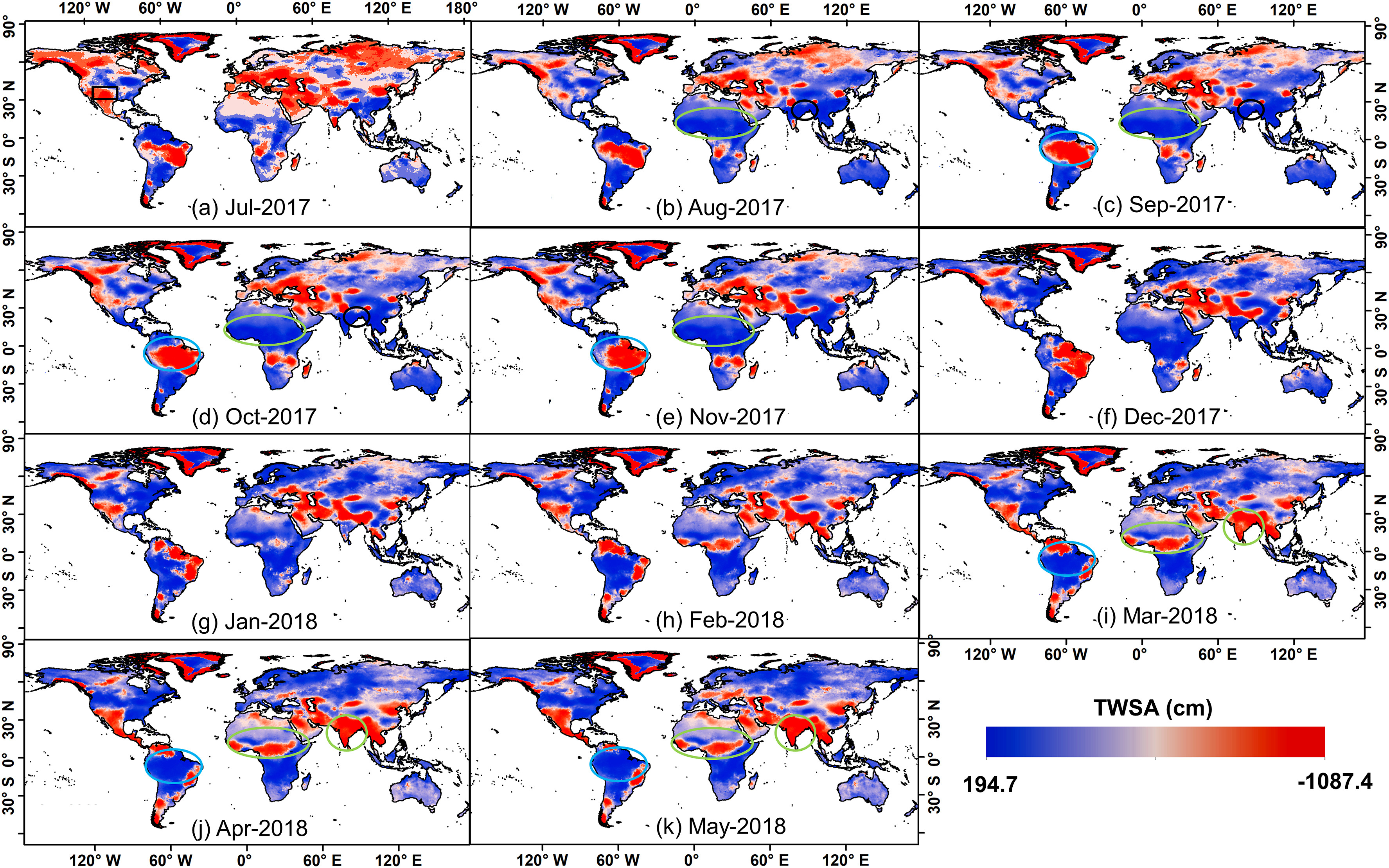
The Gravity Recovery and Climate Experiment (GRACE) and GRACE Follow-On (GFO) missions have provided valuable data for monitoring global terrestrial water storage anomalies (TWSA) over the past two decades. However, the nearly one-year gap between these missions pose challenges for long-term TWSA measurements and various applications. Unlike previous studies, we use a combination of Machine Learning (ML) methods—Random Forest (RF), Support Vector Machine (SVM), eXtreme Gradient Boosting (XGB), Deep Neural Network (DNN), and Stacked Long-Short Term Memory (SLSTM)—to identify and efficiently bridge the gap between GRACE and GFO by using the best-performing ML model to estimate TWSA at each grid cell. The models were trained using six hydroclimatic variables (temperature, precipitation, runoff, evapotranspiration, ERA5-Land derived TWSA, and cumulative water storage change), as well as a vegetation index and timing variables, to reconstruct global land TWSA at 0.5° grid resolution. We evaluated the performance of each model using Nash-Sutcliffe Efficiency (NSE), Pearson's Correlation Coefficient (PCC), and Root Mean Square Error (RMSE). Our results demonstrate test accuracy with area weighted average NSE, PCC, and RMSE of 0.51 ± 0.31, 0.71 ± 0.23, and 4.75 ± 3.63 cm, respectively. The model's performance was further compared across five climatic zones, with two previously reconstructed products (Li and Humphrey methods) at 26 major river basins, during flood/drought events, and for sea-level rise. Our results showcase the model's superior performance and its capability to accurately predict data gaps at both grid and basin scales globally.
Recommended citation: Dharpure, J.K., Howat, I.M., & Kaushik, S. (2024). Declining Groundwater Storage in the Indus Basin Revealed Using GRACE and GRACE-FO Data. Water Resources Research.
Download Paper