
Declining groundwater storage in the Indus basin revealed using GRACE and GRACE‐FO data
Published in Water Resources Research, 2025
Abstract
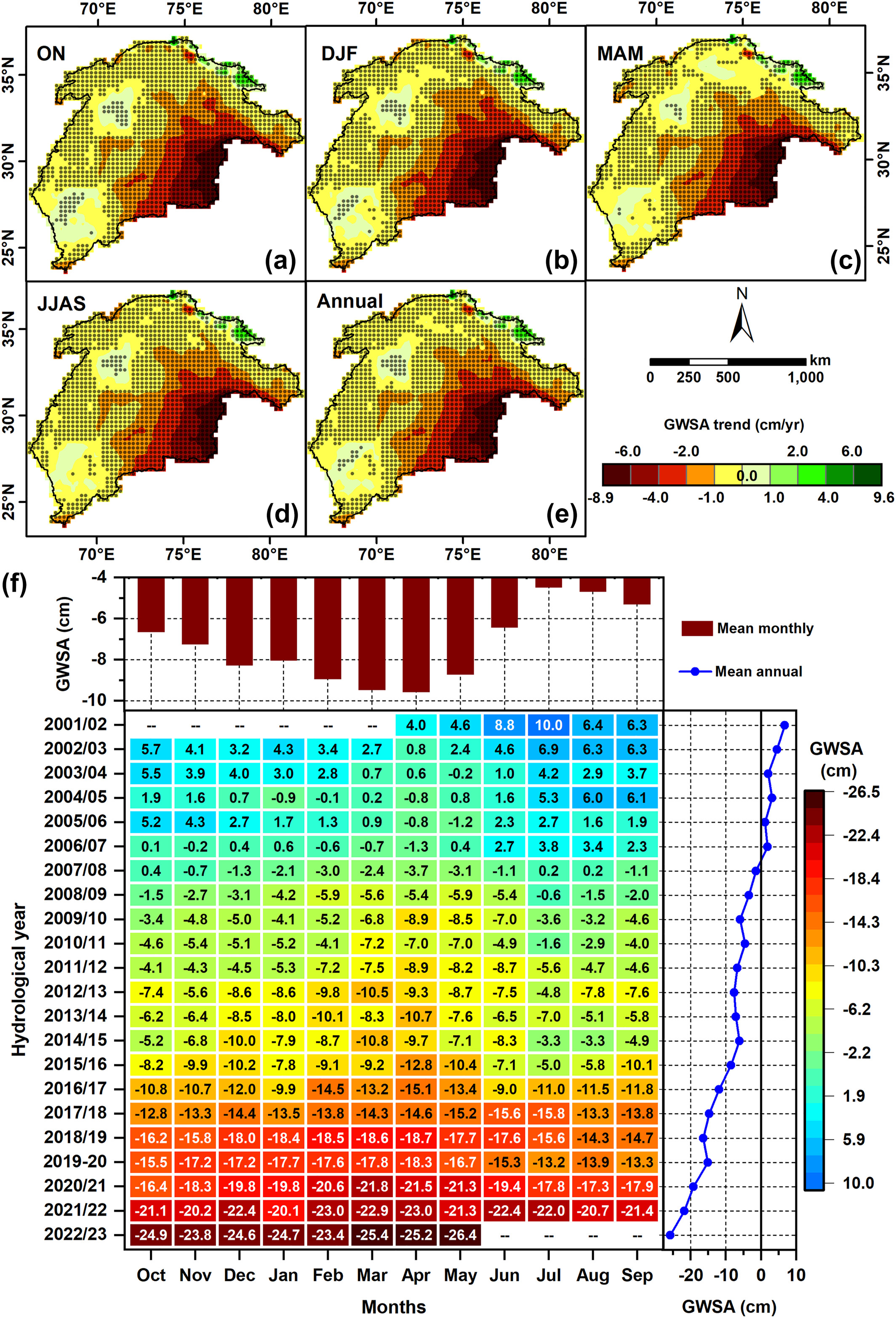
Snow and glacier melt provide freshwater to millions of people in the Indus basin. However, the unprecedented increase in demand for freshwater and depleting resources due to climate warming has put the region's water resources at risk. Therefore, quantifying water mass variation and anticipating changes in hydrological regimes that affect downstream freshwater supply are of utmost importance. To address this, we used Gravity Recovery and Climate Experiment (GRACE) and GRACE Follow-On derived terrestrial water storage anomaly (TWSA) data from April 2002 to May 2023 over the Indus basin. Several gaps in these data, totaling 33 months, significantly impact regional trends and predictions of water mass changes. We apply a machine learning-based MissForest algorithm to fill these gaps and compare our results with four previous studies. Annual TWSA shows a declining trend (−0.65 cm/yr) before 2015/16, with a significantly higher (−2.16 cm/yr) after 2015/16. Based on the estimate for the annual groundwater storage anomaly (GWSA), a major portion (83.7%) of the basin is experiencing a significant declining trend (>−0.15 cm/yr, p < 0.05). Glaciated region has a less severe decreasing trend (−0.78 cm/yr) compared to the non-glaciated region (−1.44 cm/yr). Among sub-basins, the upper Indus shows the lowest decline (−0.42 cm/yr), while Panjnad exhibits the highest (−1.70 cm/yr). Annual precipitation and runoff are decreasing, while temperature shows no trend. However, evapotranspiration is increasing, likely due to a significant increase in vegetation (0.23%/yr) over the basin. The trends of hydroclimatic variables, vegetation, and anthropogenic factors indicate a consistently decreasing GWSA in the region.
Recommended citation: Dharpure, J. K., Howat, I. M., & Kaushik, S. (2025). Declining groundwater storage in the Indus basin revealed using GRACE and GRACE‐FO data. Water Resources Research, 61(2), e2024WR038279.
Download Paper